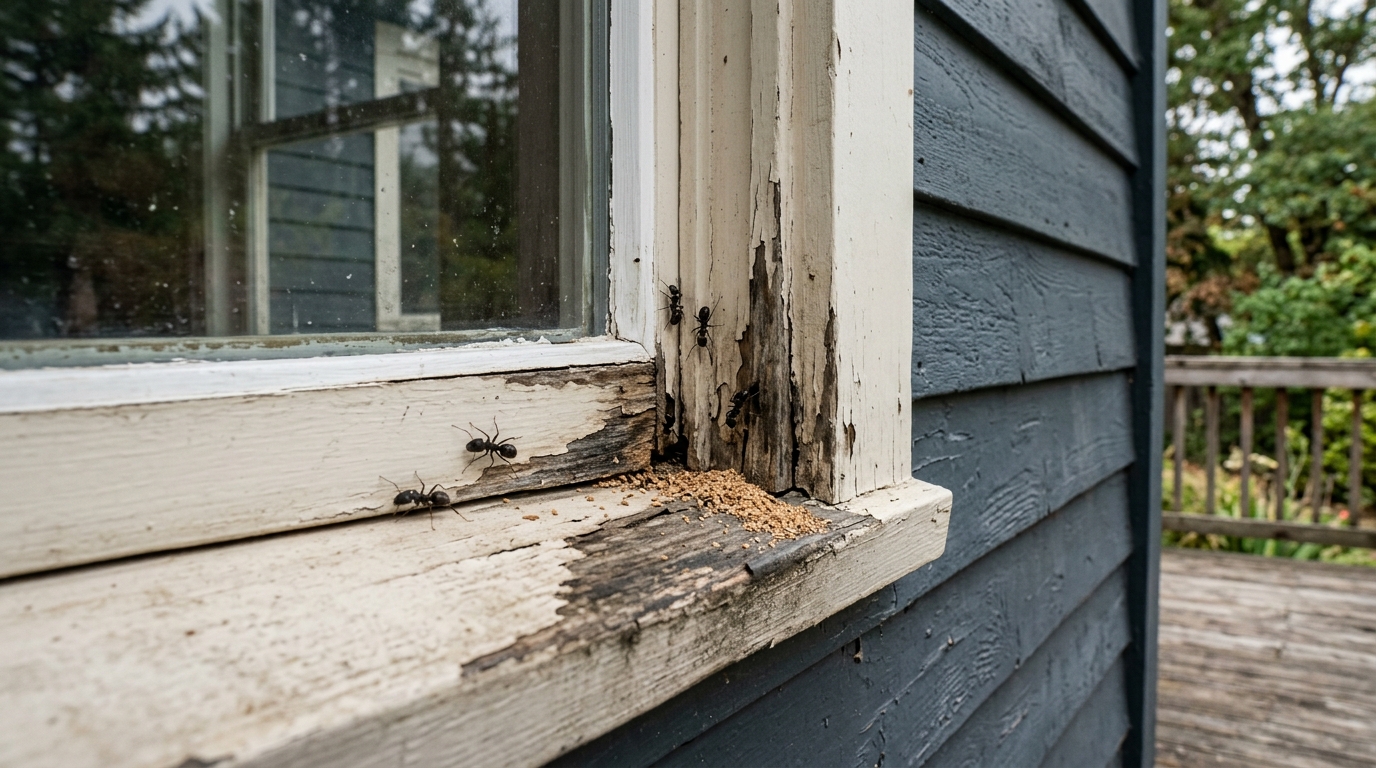
If you've seen large black ants — sometimes more than half an inch long — inside your home during winter or spring, you likely have carpenter ants. In Southern Oregon, Camponotus modoc and Camponotus vicinus are the dominant species, and both are capable of causing serious structural damage over time. Unlike termites, carpenter ants don't eat wood — they excavate it to create nesting galleries, leaving behind smooth, clean tunnels that weaken structural members silently over years.
How to Identify Carpenter Ants
Carpenter ants are the largest ants you'll find in Oregon. Key identification features:
- Size: ½ to ¾ inch — noticeably larger than any other ant species in the home
- Color: Jet black, or black with a reddish-brown midsection
- Antennae: Elbowed (bent at a sharp angle) — never straight like termite antennae
- Waist: Single rounded node between thorax and abdomen — smooth, not bumpy
- Wings (swarmers): Front wings longer than rear wings — opposite of termite swarmers
Carpenter Ant vs. Termite: Key Differences
Both create structural damage, but they leave different evidence. Carpenter ant galleries are smooth and clean, almost sand-papered in appearance. Termite galleries are rough and packed with soil and frass. Carpenter ants push frass — a mix of coarse sawdust and insect body parts — out of their galleries. If you find small piles of material that looks like coarse pencil shavings mixed with insect legs and body parts near baseboards or wall voids, that's carpenter ant frass.
Why Carpenter Ants Choose Your Home
Carpenter ants nest almost exclusively in wood that has been softened by moisture damage. They are not attacking healthy, dry wood — they're exploiting wood that is already compromised by a leak, condensation problem, or poor drainage. The most common nesting sites in Southern Oregon homes include:
- Window and door frames with failed caulking
- Roof eaves and soffits with moisture damage
- Decks and porches with water-trapping design flaws
- Crawl space sill plates with ground moisture exposure
- Areas around bathtubs, showers, and under sinks
The Satellite Colony Problem
What makes carpenter ants particularly challenging is their satellite colony structure. The main colony (typically in a rotting stump or dead tree outdoors) sends workers out to establish satellite colonies inside homes. These satellite colonies don't have a queen — they're worker populations that maintain trails back to the main colony. Treating only the indoor satellite while the outdoor parent colony remains active means the infestation will return.
What Actually Works
Effective carpenter ant control requires finding and treating both the satellite and parent colonies. This typically involves baiting along foraging trails, treating wall voids and structural members where galleries exist, and addressing the moisture problem that attracted them in the first place. Without fixing the moisture source, any treatment is temporary.
Store-bought ant sprays kill the workers you see but signal the colony to reroute — making the problem harder to solve. Professional bait formulations are carried back to the colony and shared among workers, eliminating the population systematically.
If you're seeing large black ants inside your home — especially during winter when they wouldn't normally forage outdoors — call A-One Natural Exterminators immediately at (541) 472-1094. Winter indoor activity almost always means an active colony is living inside your structure.