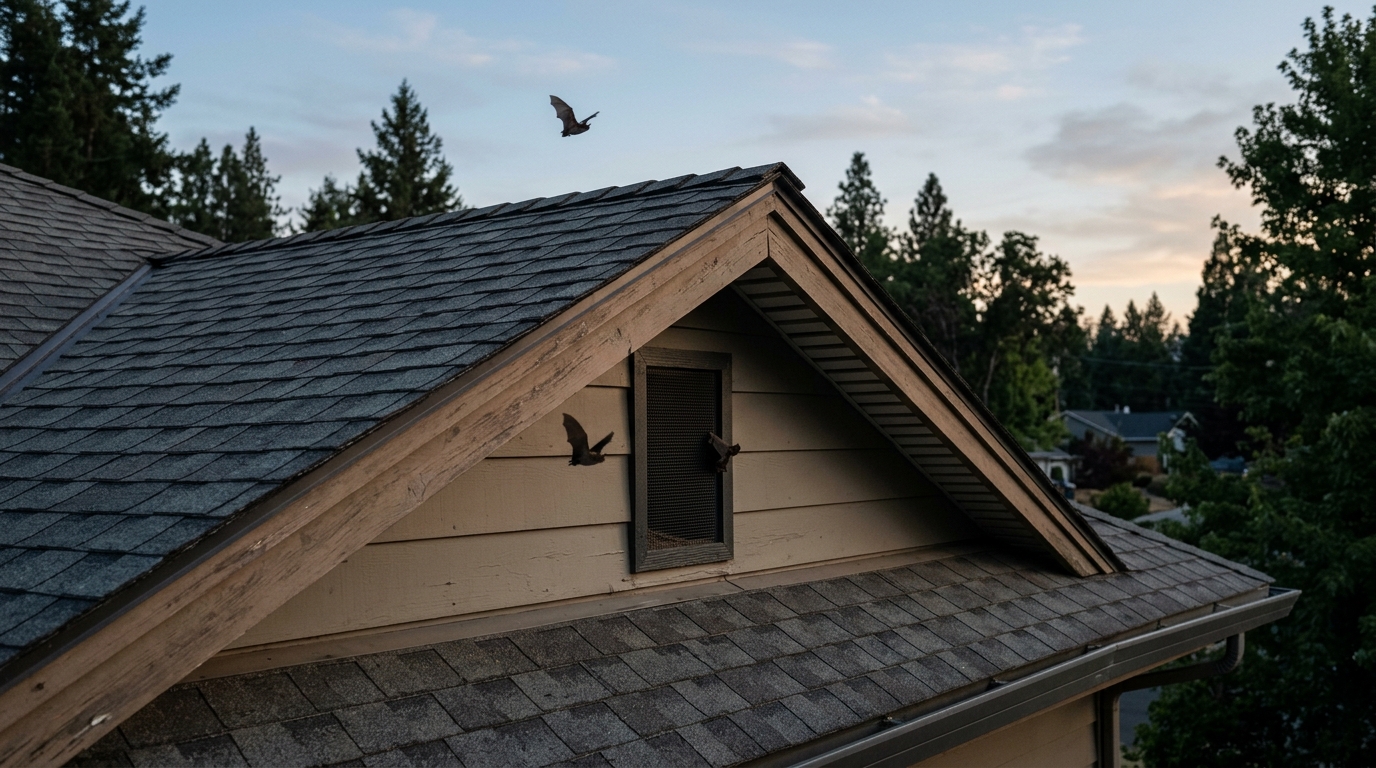
Few wildlife encounters unsettle homeowners more than discovering bats in the attic. In Southern Oregon, the Little Brown Bat (Myotis lucifugus) and the Big Brown Bat (Eptesicus fuscus) are the species most commonly found roosting in residential structures. Before you attempt any removal — or even enter the space — there are critical facts you need to understand.
Bats Are Federally Protected
Under the Migratory Bird Treaty Act and various state regulations, bats cannot be killed, harmed, or harassed. This means you cannot use poisons, traps, or any method that would injure or kill bats. Violations carry significant fines. The only legal removal method is exclusion — sealing the structure so bats can exit but not re-enter. And even exclusion has strict seasonal limitations.
The Maternity Season Restriction Is Critical
In Oregon, bat exclusion is prohibited from approximately May 1 through August 15 — the maternity season when mothers are nursing non-flying pups. If you seal entry points during this period, flightless young bats will die inside your structure, creating a serious odor problem and additional health hazards. Exclusion must be performed before May 1 or after August 15 when all bats can fly and exit independently.
The Real Health Risks
Bats in a structure pose two primary health concerns:
Histoplasmosis
Bat guano (droppings) can harbor Histoplasma capsulatum — a fungal spore that causes Histoplasmosis, a respiratory infection that can range from mild flu-like symptoms to severe lung disease. The spores become airborne when guano is disturbed. Never enter an area with significant guano accumulation without proper respiratory protection (N95 minimum, P100 preferred) and never dry sweep guano.
Rabies
Bats are the leading source of human rabies exposure in the United States. Critically, bat bites can be too small to see or feel. If you wake up in a room where a bat was present, or if a bat was found near a sleeping child or an unaware person, the Oregon Health Authority recommends consulting with a healthcare provider about post-exposure prophylaxis — even without a visible bite. Rabies is nearly 100% fatal once symptoms appear, but post-exposure treatment is nearly 100% effective when started promptly.
Signs of a Bat Roost
- Guano accumulation below entry points — looks like mouse droppings but crumbles to powder and contains insect wing fragments that glitter
- Oily brown staining around entry holes from bat body oils
- Chattering and scratching sounds from the attic at dusk and dawn
- Visible flight activity emerging from eaves at dusk
- Strong ammonia odor from urine in larger roosts
The Exclusion Process
Professional bat exclusion involves a detailed inspection to locate all entry points (bats can squeeze through a gap as small as ⅜ inch), installation of one-way exclusion devices that allow bats to exit but not return, verification that all bats have left, and then permanent sealing of all entry points. Guano remediation — proper cleanup and decontamination — is typically required afterward.
The Ecological Importance of Bats
Despite the concerns, bats are extraordinarily valuable. A single Little Brown Bat can consume 600-1,000 mosquitoes per hour. A nursing mother may eat her entire body weight in insects nightly. Oregon's bat populations face significant pressure from White-Nose Syndrome, a devastating fungal disease. This is part of why their legal protection matters — we can exclude them from our homes humanely while preserving the local population.
If you've found evidence of bats in your home, contact A-One Natural Exterminators immediately. Timing is everything with bat exclusion, and acting before maternity season (May 1) or scheduling for fall gives you the full legal window for safe, effective removal. Call us at (541) 472-1094.